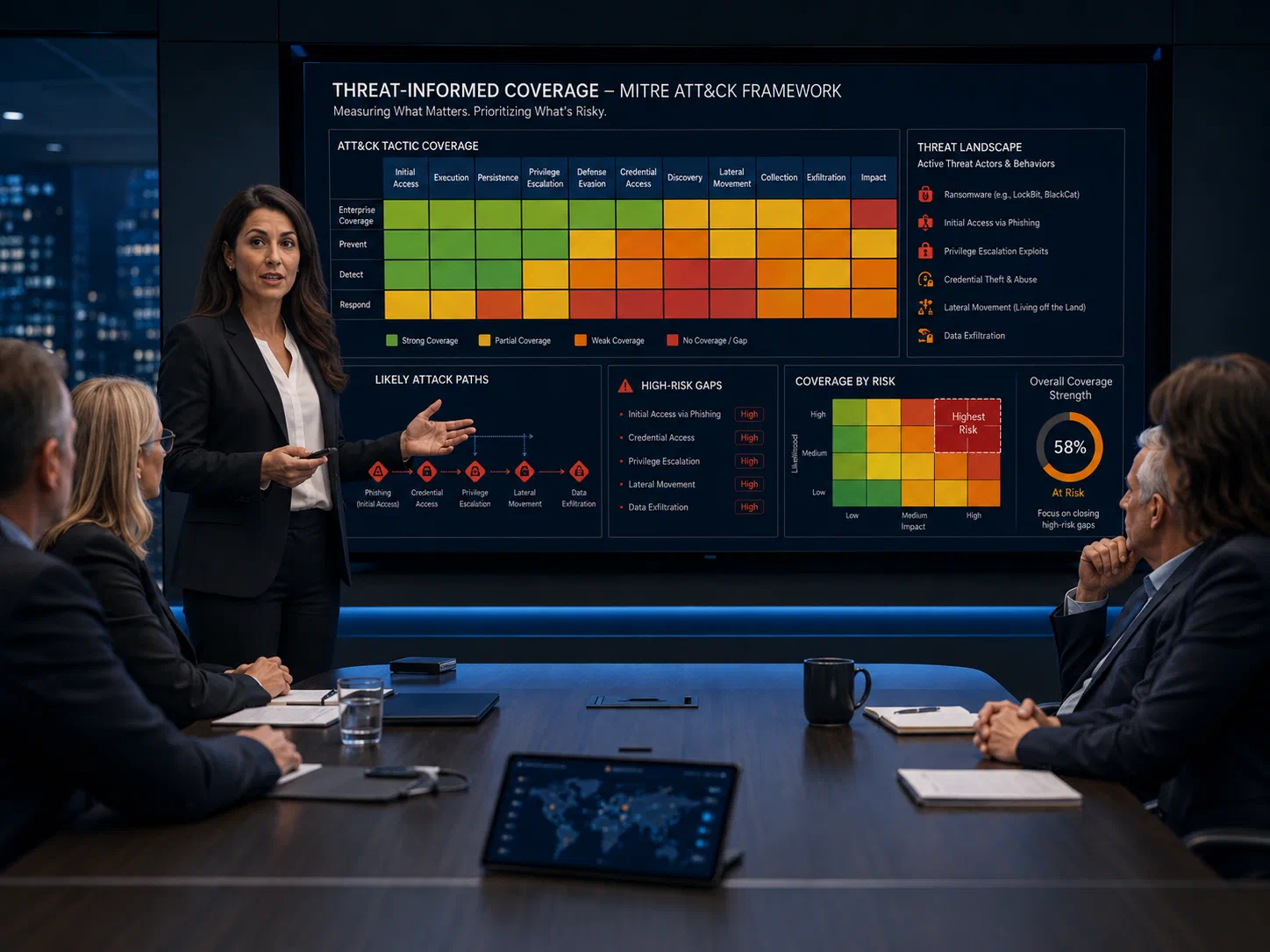
Boards do not want technique IDs.
They are not looking for a walkthrough of T1059, T1078, or any other ATT&CK identifier. What they want to understand is much simpler and much more important: which types of attacks the organization is meaningfully prepared to withstand, where the important gaps remain, and what the next investment is expected to improve.
Translation, not technical density
MITRE ATT&CK is an excellent tool for practitioners. It provides a shared language for describing adversary behavior and mapping defensive coverage. But when that detail is presented directly to a board without translation, the conversation usually fails. Technical density does not create clarity. In many cases, it creates distance.
The more effective approach is to translate techniques into outcomes. Instead of focusing on the framework itself, the discussion should center on exposure, priority, and impact. Which attack paths are currently realistic concerns for the organization? Where is coverage weakest relative to those concerns? If the program invests in a particular initiative, what exposure does that reduce? And how will anyone know that the investment worked?
This kind of framing helps the board participate in the decision rather than simply receiving a technical briefing. It also creates a healthier relationship between security leadership and executive stakeholders. The board does not need to become fluent in ATT&CK. It needs enough visibility to support prioritization and investment decisions with confidence.
Coverage moves when work gets executed
Good board reporting usually follows a straightforward structure. It explains where the organization is exposed, what that exposure means in practical terms, what it would take to reduce it, and how improvement will be measured.
That last point is where most reporting quietly breaks down. Coverage on a heat map does not change because a gap was identified — it changes when the initiative behind that gap is owned, executed, and evidenced. A board shown the same shaded matrix quarter after quarter, with no visible link to work in flight, has no way to tell whether the program is actually moving. Tie each gap to tracked work and the next review shows progress rather than a restatement.
When those elements are present, the conversation becomes much more useful. Technique-level detail can remain with the security team. The board needs the story: exposure, priority, investment, and result.
Security leaders who can make that translation consistently are far better positioned to earn support for the program. They move the discussion away from abstract technical coverage and toward decisions the board is actually there to make.